
The Emerging Disruption of Tokenized Assets as Core Financial Infrastructure
The next decade is poised to witness a profound transformation in financial services driven by the rise of tokenized assets, particularly stablecoins, evolving beyond their crypto origins into critical infrastructure for global commerce. A subtle but growing shift is underway: stablecoins and other tokenized assets are beginning to be integrated into mainstream financial systems, suggesting a future where digital assets are not peripheral novelties but central pillars of capital management, treasury allocation, and cross-border trade. This weak signal of tokenized finance mainstreaming could disrupt multiple industries by fundamentally altering capital flows, regulatory landscapes, and corporate strategies.
What’s Changing?
The momentum behind tokenized assets—in particular stablecoins, which are digital currencies pegged to traditional fiat currencies—is accelerating rapidly. Recent reports indicate that a growing majority of companies plan to add tokenized assets to their portfolios in 2026, with some aiming to allocate in excess of 5% of their total capital to these instruments (MEXC).
This mainstreaming of tokenized assets is driven by several intertwined developments. Legal and regulatory clarity around stablecoins has notably increased in the U.S., with stablecoins now operating under a defined federal framework. Banks have resumed custody roles, and digital assets have been integrated into regulated exchanges, lending legitimacy and stability previously lacking in the sector (Blockforce Capital).
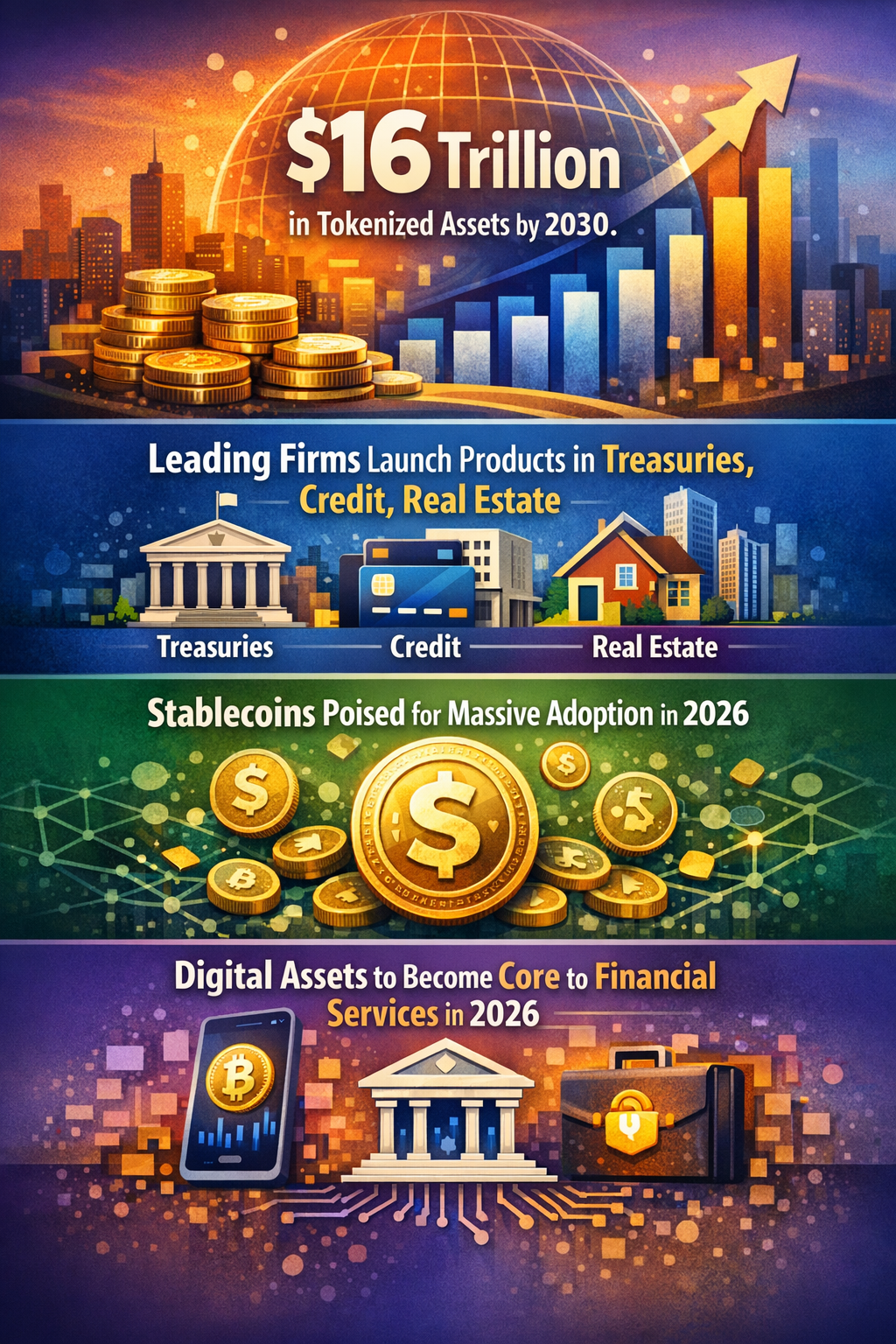
Institutional adoption is reflected in projections from leading financial firms. For example, Standard Chartered forecasts that stablecoins and tokenized assets on the Ethereum blockchain could each exceed $2 trillion in market value by 2028, while other analysts anticipate tokenized assets could reach $16 trillion by 2030 across multiple asset classes including treasuries, credit instruments, and real estate (FXStreet, Cryptonomist).
Venture capital insights reinforce that the adoption of tokenized assets is not a passing phase but is expected to represent a secular growth trend over the coming one to two decades (DL News). These instruments are increasingly viewed not merely as crypto securities but as efficient, programmable financial infrastructure capable of supporting global commerce at scale (ChainUp).
The convergence of tokenized finance with artificial intelligence (AI) and corporate governance strategies signals deeper shifts in how entities will manage the interface between human and machine intelligence, capital allocation, and risk management going forward (FinTech Times).
Another noteworthy development is the anticipated prioritization of stablecoins and productive tokenized assets as dominant targets for treasury inflows in corporate finance, suggesting corporate treasurers will increasingly deploy such instruments to optimize liquidity management, reduce settlement times, and hedge risks (DL News).
Why is this Important?
The evolution of stablecoins from peripheral crypto assets to foundational financial tools could redefine traditional banking, capital markets, and cross-border commerce. Key drivers include:
- Risk and regulatory management: Regulatory clarity reduces legal uncertainty and unlocks institutional trust, positioning tokenized assets as regulated instruments akin to traditional financial products.
- Operational efficiency: Tokenized assets can automate securities issuance, transfer, and settlement through blockchain technology, potentially reducing costs and counterparty risks.
- Liquidity and market access: Digital tokens allow fractional ownership and 24/7 global trading, broadening investor bases and improving assets’ liquidity profiles.
- New corporate treasury strategies: Firms may shift cash management toward tokenized stablecoins and digital assets, aligning liquidity with investment and risk objectives in real time.
- Cross-sector disruption: Real estate, credit markets, and even sovereign treasuries are seeing tokenized asset introductions, implying a shift beyond just crypto-focused industries.
This convergence could challenge legacy players to innovate or risk losing relevance as tokenized finance erodes traditional intermediaries’ value propositions. The broad adoption this implies might also prompt governments and regulators worldwide to reassess monetary policy frameworks, financial stability protocols, and oversight mechanisms to accommodate tokenized asset flows embedded within global finance.
Implications
The transition toward widespread use of tokenized assets and stablecoins as core financial infrastructure will reconfigure business models across sectors and geographies. Entities may need to:
- Rethink treasury and liquidity management: With predictive tools and programmable assets, corporate treasurers could optimize working capital in dynamically tokenized forms.
- Integrate AI and token systems: Firms managing hybrid intelligence strategies may leverage algorithmic trading, compliance automation, and digital identity linked to tokenized portfolios.
- Expand financial product innovation: Financial institutions could harness tokenization for customized credit products, fractionalized real estate investments, and instant settlement bonds.
- Engage regulators proactively: Given regulatory frameworks are evolving, active collaboration will be vital for compliance and to influence standards that balance innovation with safety.
- Address cybersecurity and operational resilience: The digital-native nature of tokenized assets elevates the importance of robust cyber defenses and disaster recovery planning.
- Prepare workforce skills: Talent acquisition and training to bridge finance, technology, and compliance expertise will become critical.
The wide-ranging impact of tokenized finance might also accelerate financial inclusion by democratizing access to diverse assets via fractional tokens and lowering transaction costs for underserved markets. Multinational corporations could seize competitive advantages by adopting tokenized liquidity management early, gaining speed and accuracy in capital deployment.
Questions
- How might existing treasury operations need to evolve to incorporate tokenized assets while managing regulatory compliance and operational risks?
- What frameworks should organizations develop to evaluate tokenized assets alongside traditional investments for risk-return profiles?
- In what ways could tokenized asset adoption alter capital markets’ structure, and how should corporations prepare for these shifts?
- How can regulators and industry players collaborate to establish standards that support innovation without compromising financial stability?
- What technological integrations between AI, blockchain, and legacy financial systems will be necessary to fully leverage tokenized finance?
- How might tokenization impact cross-border trade and currency exchange mechanisms over the next decade?
Keywords
tokenized assets; stablecoins; blockchain; corporate treasury; financial regulation; digital assets; liquidity management
Bibliography
- 76% of companies plan to add tokenized assets in 2026 with some eyeing 5% + of their entire portfolio. MEXC. https://www.mexc.com/en-NG/news/299018
- Legal risk has receded, stablecoins operate under a clear federal framework, bank custody is restored, spot markets are integrated into regulated exchanges, and digital assets are now part of long-term U.S. monetary and strategic planning. Blockforce Capital. https://blockforcecapital.com/the-node-ahead-105-the-3-biggest-stories-of-2025/
- Standard Chartered projects stablecoins and tokenized assets on Ethereum could each reach $2 trillion by 2028, though JP Morgan maintains a more conservative outlook. FXStreet. https://www.fxstreet.com/cryptocurrencies/news/ethereum-annual-price-forecast-eth-poised-for-growth-in-2026-amid-regulatory-clarity-and-institutional-adoption-202512241600
- Analysts forecast $16 trillion in tokenized assets by 2030, while leading firms launch products spanning treasuries, credit, and real estate. Cryptonomist. https://en.cryptonomist.ch/2025/12/06/digital-assets-forum-london/
- We expect adoption of stablecoins and other tokenised assets to continue accelerating in 2026 and to represent a secular growth trend over the next one to two decades. DL News. https://www.dlnews.com/articles/deals/what-vcs-expect-to-see-for-crypto-investments-in-2026/
- The next decade will be defined by the convergence of artificial intelligence, tokenised finance, and a fundamental shift in how corporations manage human and machine intelligence. FinTech Times. https://thefintechtimes.com/capital-insights-vol2-issue-4-roadmap-for-digital-disruption-by-2035/
- Stablecoins and productive assets are likely to become the dominant marginal allocation of treasury inflows in 2026. DL News. https://www.dlnews.com/research/internal/state-of-defi-2025/
- Stablecoins will cease to be viewed as crypto instruments and instead become recognized as efficient financial infrastructure for global commerce. ChainUp. https://www.chainup.com/blog/10-predictions-for-global-crypto-industry/