
The Emerging Disruption of Real-World Asset Tokenization and Decentralized Finance Integration by 2030
Real-world asset tokenization—converting tangible assets into digital tokens on a blockchain—could evolve into a transformative force across multiple industries by 2030. This weak signal, gaining traction in 2026, is poised to move beyond niche experiments to large-scale adoption, integrating traditional finance with decentralized finance (DeFi) protocols. The convergence could disrupt investment practices, reshape finance, and automate operational processes in unprecedented ways.
What's Changing?
Tokenization of assets transforms ownership rights into digital tokens, enabling them to be traded, divided, and managed on blockchain networks. While initial efforts focused on cryptocurrencies, a surge is underway to tokenize real-world assets—including real estate, fine art, commodities, and even company equity. By 2030, these real-world assets (RWAs) could represent an additional $2 trillion or more in tokenized value, unlocking liquidity previously trapped in illiquid markets (Yahoo Finance).
Several developments in 2026 signal the acceleration of this trend. Tokenized assets are shifting from pilot projects into broader adoption across sectors like banking, investment, and supply chain management (Differ Blog). This transition requires emerging expertise in blockchain architecture, smart contract development, and decentralized system integration—skills that companies increasingly seek (USCSI).
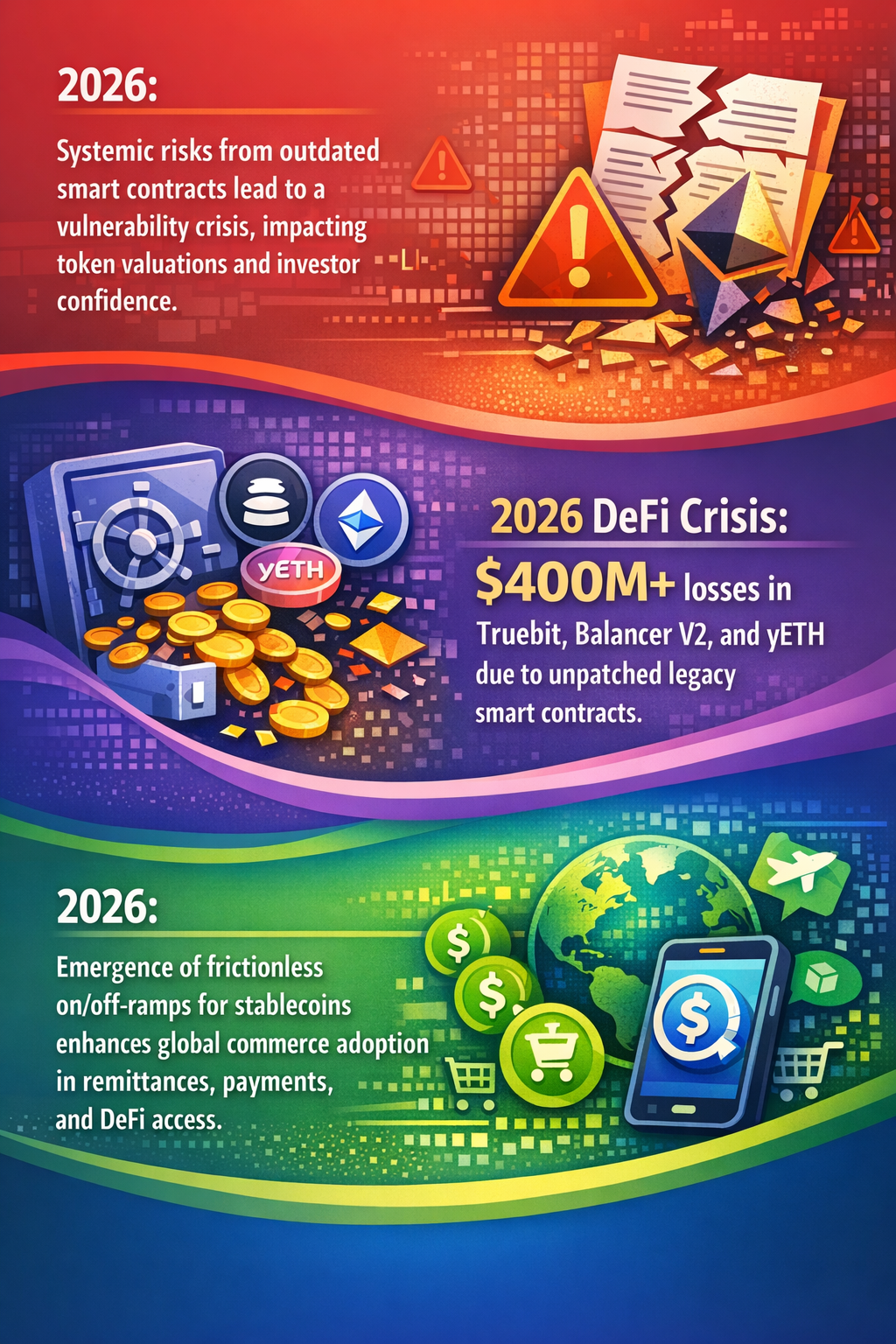
Central to this evolution is the growing integration between traditional financial systems and DeFi platforms. DeFi allows financial services—lending, borrowing, trading—to operate without intermediaries, using smart contracts to automate execution and settlement. By 2026, these platforms are expected to embed more deeply within traditional finance networks, enabling frictionless on- and off-ramps for stablecoins and tokenized assets across global commerce, remittances, and payments (OAX) (Memo Labs).
At the technical layer, stablecoins—digital currencies pegged to fiat currencies—are driving new demand structures within corporate treasuries, potentially surpassing baseline productivity models (Forbes). Meanwhile, insecurities in legacy smart contracts triggered a crisis in 2026, highlighting the systemic risks of immature or unpatched code in DeFi ecosystems, with over $400 million in losses reported in projects such as Truebit and Balancer V2 (AInvest).
This confluence of trends—the rapid expansion of real-world asset tokenization, the mainstream integration of DeFi with established financial systems, and the increasing automation through smart contracts—marks a critical point of change. Institutions exploring tokenized RWAs find novel opportunities and challenges on the horizon, potentially reshaping investment, lending, and accounting practices (Amberdata Blog).
Why is this Important?
The expansion of real-world asset tokenization could vastly increase market liquidity, allowing investors to buy fractions of high-value assets and broaden participation beyond traditional investor classes. This liquidity could spur new financial products, improve capital allocation efficiency, and lower transaction costs.
The deepening convergence of DeFi and traditional finance stands to automate and streamline numerous financial operations. Smart contracts automating routine transactions could reduce operational overhead and errors in accounting, potentially enabling near-zero human touch accounting functions within a decade (Abeam Insights).
However, this evolution introduces new systemic risks. The smart contract breaches in 2026 demonstrate how vulnerabilities in code can lead to significant financial losses and undermine confidence. This indicates a pressing need for improved standards, auditing, and regulatory frameworks to safeguard stakeholders.
For governments and regulators, tokenization challenges existing infrastructures for ownership verification, taxation, and compliance. Coordinated policy development may be required to manage cross-border issues and ensure consumer protection without stifling innovation.
Businesses should consider the potential for tokenization to disrupt asset management and finance roles, creating demand for blockchain specialists and driving digital transformation. Institutions that embrace these trends early may gain competitive advantage by offering innovative products and services.
Implications
The rise of asset tokenization and DeFi integration implies several strategic imperatives:
- Technology Investment and Expertise: Firms may need to invest in blockchain infrastructure and upskill teams in smart contract development and cybersecurity to compete effectively.
- Risk Management and Governance: Organizations must develop robust frameworks to address smart contract vulnerabilities, including code audits, fail-safe mechanisms, and incident response plans.
- Regulatory Engagement: Active collaboration with regulators could help shape policies that enable tokenization benefits while mitigating financial crime, fraud, and systemic risks.
- Business Model Innovation: Tokenization can unlock new liquidity and financing models, such as fractional ownership and real-time settlement, urging business model redesign to harness these capabilities.
- Cross-sector Collaboration: The integration of traditional finance and DeFi will likely require partnerships across industries—from banking and insurance to real estate and supply chain—to realize end-to-end value.
- Customer Education: As tokenized assets become more accessible, enterprises must educate customers and investors on risks, rights, and governance mechanisms embedded in tokenized ownership.
Foresight into these developments could also spotlight the need for enhanced data transparency and interoperability standards, further enabling seamless interaction between decentralized and centralized financial networks.
Questions
- How can organizations assess and mitigate systemic risks emerging from smart contract vulnerabilities before large-scale losses occur?
- What frameworks will regulators develop to balance innovation with consumer protection and financial stability in tokenized asset markets?
- In what ways might tokenized real-world assets democratize access to investment and capital markets, and what unintended consequences could arise?
- How will integration of DeFi and traditional finance transform accounting, auditing, and compliance processes in the next decade?
- What new business models could emerge from the capability to fractionalize ownership of high-value and illiquid assets?
- How might enterprises prepare their workforce to acquire the necessary skills to design, integrate, and secure blockchain and smart contract systems?
Keywords: real-world asset tokenization; decentralized finance; smart contracts; blockchain integration; stablecoins; financial automation; cybersecurity; tokenized assets
Bibliography
- Real-world asset tokenization of other assets could reach a further $2 trillion or more by 2030. Yahoo Finance. https://finance.yahoo.com/news/cryptocurrency-could-one-best-own-101200346.html
- By 2026, tokenized assets will move beyond pilot projects into mainstream adoption. Differ Blog. https://differ.blog/p/the-10-key-industries-to-watch-as-real-world-asset-tokenization-takes-baa283
- In 2026, companies will require experts capable of designing and developing blockchain architectures, creating smart contracts, and integrating decentralized systems into existing systems. USCSI. https://www.uscsinstitute.org/cybersecurity-insights/blog/top-it-skillset-that-will-dominate-in-2026
- After digital money spreads widely throughout society and the automation value of smart contracts is recognized, the next thing to come into view will be a world where accounting operations are almost fully automated, with near-zero human touch. Abeam Insights. https://www.abeam.com/kr/en/insights/175/
- In 2026, the convergence between traditional finance and decentralized finance (DeFi) is expected to become more pronounced. Nation Thailand. https://www.nationthailand.com/business/banking-finance/40061438
- In 2026, DeFi platforms will integrate more deeply with traditional financial systems, moving beyond niche experimentation and into mainstream adoption. Memo Labs. https://blog.memolabs.org/the-2026-crypto-landscape-what-to-expect-and-how-memo-is-at-the-forefront/
- In 2026, expect emergence of frictionless on/off-ramps that plug stablecoins into global commerce, boosting adoption for remittances, payments, and DeFi access. OAX. https://www.oax.org/2026/01/11/Looking-Ahead-at-Key-Trends-Shaping-2026.html
- AI could accelerate productivity beyond anything the baseline projections anticipate, and stablecoins are creating structural Treasury demand that did not exist a decade ago. Forbes. https://www.forbes.com/sites/davidbirnbaum/2026/01/07/bitcoin-ai-and-the-4-forces-shaping-the-new-economy/
- 2026 DeFi crisis exposes systemic risks from unpatched legacy smart contracts, causing $400M+ losses in Truebit, Balancer V2, and yETH breaches. AInvest. https://www.ainvest.com/news/smart-contract-vulnerability-crisis-era-defi-risk-2026-2601/
- The Bridge Between Trillions in Traditional Assets and DeFi. Amberdata Blog. https://blog.amberdata.io/the-rise-of-tokenized-real-world-assets-rwas-opportunities-and-challenges-for-institutional-investors?hs_amp=true