
The Rising Squeeze on Carbon Offset Integrity: A Weak Signal with Structural Implications for Green Finance
Carbon credit markets are evolving rapidly, but a subtle yet powerful pressure on voluntary offset quality is emerging. This development could recalibrate capital flows, regulatory mandates, and industry structures supporting global decarbonization within the next decade.
The current debate around carbon offset pricing signals an inflection point: escalating demand for verifiable, high-integrity offsets poised to disrupt existing credit supply chains and investment paradigms. While headline discussions focus on rising prices, an under-examined weak signal lies in how offset quality demands may bifurcate the market and reshape finance, governance, and climate accountability frameworks. This paper evaluates this emerging tension as a structural inflection with potential to alter capital allocation, regulatory oversight, and strategic positioning in sustainability finance over the next 5–10 years.
Signal Identification
This development qualifies as an emerging inflection indicator within green and sustainable finance. It moves beyond price volatility and into quality validation, reflecting growing scrutiny of carbon credits' environmental integrity. The signal’s time horizon is medium-term—5 to 10 years—with a medium to high plausibility band. Key sectors exposed include carbon markets, ESG (Environmental, Social, and Governance) investing, agricultural and forestry supply chains, and regulatory bodies crafting climate disclosure and compliance frameworks.
What Is Changing
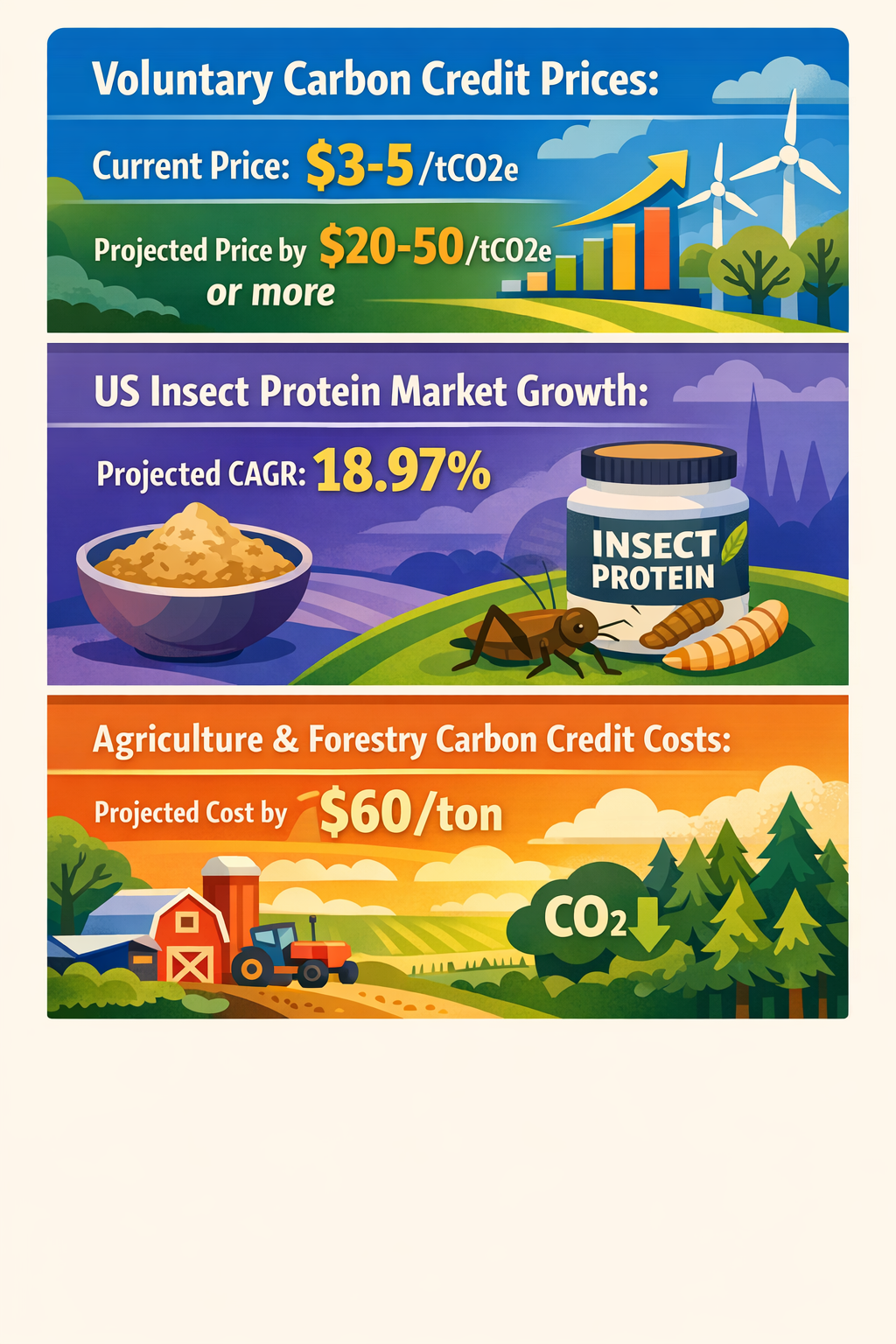
Multiple sources collectively reveal an increasing gap between the current voluntary carbon credit price range of US$3–5 per metric ton CO₂ equivalent and projections that high-quality offsets may command US$20–50 or even over US$60 by 2026 in agriculture and forestry contexts (The Conference Board 07/02/2024; Farmonaut 15/03/2024).
This price escalation is not merely economic but reflects a deeper demand for transparency, additionality, permanence, and robust verification. Increasing investments in farmer training, regenerative agriculture, and soil health technologies bolster this trend, signifying a structural upgrade in offset supply requiring new standards and technology platforms (OpenPR 20/01/2024).
Simultaneously, the surge in sustainability-linked litigation—driven by projected ESG investments reaching US$30 trillion by 2030 and rising governance scrutiny—exerts pressure on offset integrity claims and increases reputation and liability risks for market participants (PR Newswire 05/04/2024). Parallel regulatory advances, such as National Adaptation Plans in the Gulf Cooperation Council (GCC) countries focused on climate risk disclosures and adaptation finance, illustrate emerging frameworks that may embed offset quality criteria within sovereign and corporate compliance mechanisms (ORF Online 28/02/2024).
The structural theme is an incipient bifurcation: a credible high-integrity carbon credit market segment with premium pricing and regulatory endorsement that could displace or marginalize lower-quality, cheap offsets. This differential will create a credit stratification, not widely recognized, but with powerful capital allocation and governance repercussions.
Disruption Pathway
The pathway toward structural change begins with accelerating demand from corporates and governments under growing climate commitments and ESG disclosure mandates. As mainstream investors become increasingly wary of greenwashing risks, demand for premium offsets backed by scientifically verifiable outcomes may surge.
This demand exerts stress on existing carbon credit supply chains, particularly in sectors like agriculture and forestry where heterogeneity in project quality and verification standards has historically dampened issuer trust. The resulting scarcity of verifiable offsets could drive carbon prices higher, prompting capital shifts away from low-integrity credits.
Structural adaptations may include emergence of standardized high-quality offset certifications supported by blockchain or AI-driven monitoring, enhanced regulatory frameworks embedding offset quality criteria into national and international compliance schemes, and new financial instruments prioritizing high-integrity credits.
Feedback loops may reinforce this cycle: stricter standards raise entry barriers, incentivizing technological innovation and supply-side consolidation toward providers who can prove impact rigorously. However, unintended consequences could include disenfranchisement of small-scale or resource-poor providers who currently supply cheap offsets, raising equity concerns and regulatory backlash risk.
If this pathway evolves, dominant industrial and regulatory models may shift from volume-based, loosely regulated offset markets to quality-driven, tightly governed ecosystems oriented on traceability, impact verification, and risk mitigation. This will recalibrate strategic positioning for stakeholders across carbon markets, sustainable finance, and climate policy domains.
Why This Matters
For senior decision-makers, this signal bears directly on capital allocation and risk governance. Portfolios heavily reliant on volumes of low-cost offsets may face value erosion and stranded asset risks as markets and regulators recalibrate trust metrics toward quality.
Regulators may increasingly mandate robust offset integrity standards within ESG reporting and carbon market compliance infrastructures, altering the industrial structure of offset providers and intermediaries. Governments integrating sustainability into economic diversification strategies, especially in resource-rich regions like the Middle East, could leverage this signal to align sovereign debt and sustainable bond issuance with emerging offset quality benchmarks (Yahoo Finance 01/04/2024).
Financial institutions could experience shifting liability profiles amid rising ESG litigation linked to misrepresented offset claims, urging reconfiguration of governance, disclosure, and underwriting standards.
Implications
This signal may induce a structural market reallocation favoring high-integrity carbon credits and finance products aligned with rigorous sustainability outcomes. Investors might increasingly incorporate offset quality metrics into due diligence frameworks, influencing capital deployments in regenerative agriculture, forestry, and technology-driven verification platforms.
Regulatory frameworks could evolve to define offset quality thresholds explicitly, integrating them into national adaptation and mitigation reporting guidelines, as seen in emerging GCC adaptation policy alignment.
However, this is unlikely to be a simple linear progression. The signal is not a transient pricing anomaly but reflects deeper shifts in stakeholder expectations and governance models that could harden over the next decade. Competing interpretations may frame price hikes as a normalization of carbon costs rather than quality segmentation, or conversely as speculative volatility disconnected from systemic change.
The core takeaway is that offset quality demands constitute an underappreciated inflection that might transform carbon markets from collateral ESG tools into core pillars of credible, accountable climate finance.
Early Indicators to Monitor
- Emergence and adoption of internationally recognized high-integrity carbon offset certifications and standards
- Growth in financial instruments explicitly tied to verified high-quality offsets, including in sovereign green bonds
- Increase in ESG litigation cases referencing offset misrepresentation and governance failures
- Venture capital and corporate funding surges in technologies for offset monitoring, like satellite sensing and blockchain verification
- Policy and regulatory drafts integrating offset quality requirements into nationally determined contributions (NDCs) and voluntary disclosure frameworks
Disconfirming Signals
- Widespread industry consensus on offset quality standards fails to emerge or is heavily fragmented
- Carbon credit prices stabilize or decline despite growing climate commitments, indicating no market segmentation
- Regulatory frameworks continue to accept broad definitions of offset validity without quality enforcement
- Significant backlash or litigation undermines high-integrity offset verification models, leading to reputational crises
- Technology solutions for verification stall due to cost or scalability barriers, keeping quality-enhanced credits niche
Strategic Questions
- How can capital allocation strategies be adapted to preemptively favor high-quality carbon offsets and mitigate transition risks from low-integrity credits?
- What regulatory and governance frameworks need to be developed or anticipated to embed offset quality standards into national and international climate finance systems?
Keywords
Carbon Offsets; Carbon Credit Quality; Voluntary Carbon Markets; ESG Litigation; Regenerative Agriculture; Climate Finance; Green Bonds; Climate Risk Regulation
Bibliography
- The current average voluntary carbon credit price is around US$ 3-5 per metric tonne of carbon dioxide equivalent; the push toward high-quality offsets may drive prices up to US$ 20-50 / tCO2e or more by 2030. The Conference Board. Published 07/02/2024.
- Agriculture and forestry sectors could see carbon credit costs exceed $60 per ton by 2026, influencing sustainable investment choices. Farmonaut. Published 15/03/2024.
- Continued investments in farmer training, carbon credit programs, and soil health technologies will further accelerate the global shift toward regenerative agriculture systems. OpenPR. Published 20/01/2024.
- ESG related litigation continued growing in 2025, reflecting accelerating ESG investment projected to reach $30 trillion by 2030 - and increasing use of class actions for governance and sustainability goals. PR Newswire. Published 05/04/2024.
- As part of UNFCCC reporting guidelines and the Cancun Adaptation Framework, many GCC countries have started developing National Adaptation Plans that urge countries to outline climate risks and coping strategies, laying the foundation for coordination and climate finance. ORF Online. Published 28/02/2024.
- In the Middle East, sustainable bond issuance is expected to remain resilient, as governments integrate sustainability objectives into broader economic diversification strategies. Yahoo Finance. Published 01/04/2024.