
The Latent Impact of Cultural-Ecological Urban Niches on Megacity Trajectories
Exploring how culturally embedded, eco-centric urban micro-practices in rapidly growing Asia-Pacific cities may redefine megacity development beyond the conventional infrastructure and technology narratives.
The accelerating urbanization of the Asia-Pacific region heralds one of the most significant demographic shifts of the 21st century, with megacities expanding at unprecedented rates. Amid this, a subtle yet structurally potent inflection is emerging: the rise of culturally rooted ecological urban niches grounded in traditional knowledge systems, such as Ayurveda-inspired urbanism and green building adoption driven by community-led environmental awareness. This development represents an under-recognised axis of urban transformation that could disrupt prevailing infrastructure investment models, regulatory frameworks, and industrial supply chains over the next 5–20 years. Understanding how these cultural-ecological practices intersect with rapid urban growth offers senior decision-makers an expanded lens to anticipate systemic shifts in urban governance, capital deployment, and competitive positioning.
Signal Identification
This development qualifies as an emerging inflection with medium to high plausibility over a 10–20 year horizon, predominantly impacting urban infrastructure, environmental regulation, real estate development, and industrial sectors such as construction materials and food processing. It diverges from widely recognized urbanization themes centered on digitization or purely technology-driven smart city initiatives (MarketGenics 16/03/2026>; TechTime 16/03/2026). Instead, it signals the growing influence of culturally anchored environmental values and practices on how cities evolve structurally. This nexus remains underappreciated in scenario planning, potentially reshaping long-term regulatory and investment dynamics in urban ecosystems.
What Is Changing
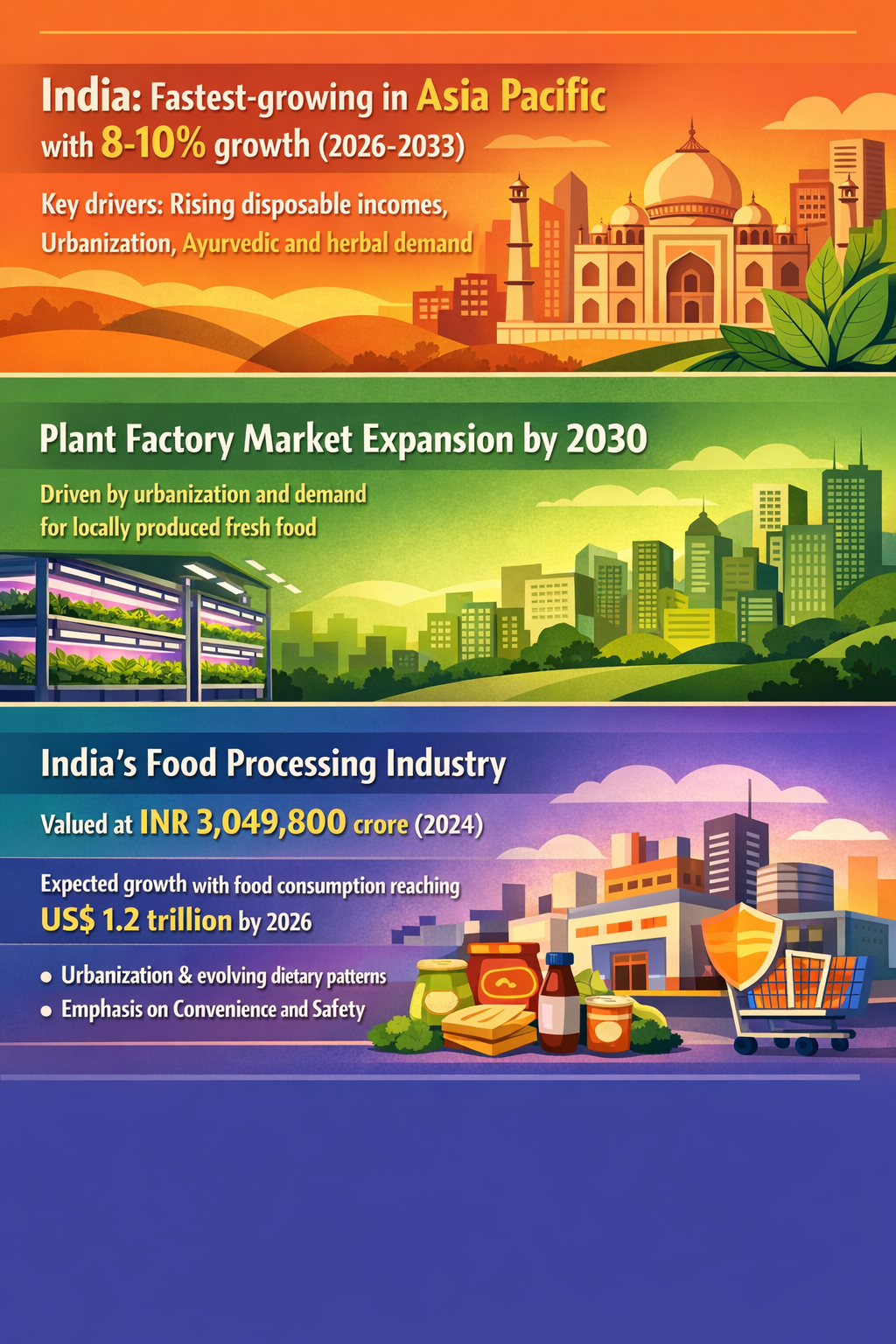
The Asia-Pacific region’s rapid urbanization velocity is evident in infrastructure expansion, increased steel consumption, and sharply rising electricity demand (Steelsathi 10/04/2024>; Dimension Market Research 25/02/2026). Embedded within this broader growth is a conspicuous cultural pattern: India, as the fastest-growing country, leverages not only rising incomes but also deep traditional affinities, particularly for Ayurvedic and herbal formulations, which influence urban consumer and lifestyle choices (Persistence Market Research 09/03/2026). Parallel to this consumer shift is a burgeoning green building market driven by enhanced environmental awareness, which integrates traditional ecological wisdom with modern design and construction standards (NatLawReview 15/02/2026).
These factors converge to form what can be classified as culturally sustained ecological niches within urban contexts. Notably, the food processing industry’s expansion aligns with evolving dietary patterns that prioritize convenience yet emphasize natural and safe ingredients, reflecting a culturally embedded demand profile (Persistence Market Research 06/04/2026). This is more than mere consumer preference; it signals shifts in urban supply chains and industrial production models tied intrinsically to cultural values.
Unlike standard smart city digitalization trends focused on Internet of Things (IoT) deployment for traffic and energy optimization (MarketGenics 16/03/2026), the cultural-ecological niche development implies a systemic reorientation — from broad technology-first approaches to culturally contextualized sustainability frameworks, which may influence zoning laws, building codes, and urban land use. Such shifts are not yet broadly recognized as drivers of megacity morphology or capital flow but could become critical determinants of urban resilience and social license over the medium term.
Disruption Pathway
This inflection could evolve structurally through several reinforcing dynamics. Increased adoption of culturally embedded green building practices — aligned with international green construction certification regimes — may prompt shifts in material sourcing, favouring regional and sustainable supply chains over conventional globalized models (NatLawReview 15/02/2026). As urban populations grow, pressure for culturally respectful, ecologically sensitive urban neighborhoods may escalate, compelling municipal regulators to integrate tradition-informed sustainability into planning processes.
Consequent stresses include conflicts between large-scale industrial development paradigms and community-driven sustainability standards, potentially triggering legal and policy contestations. Industrial sectors such as steel manufacturing or food processing may need to adapt rapidly to meet new environmental criteria shaped by cultural values, introducing operational complexity and supply chain reconfiguration (Persistence Market Research 06/04/2026; Steelsathi 10/04/2024).
Structural adaptations could include the emergence of hybrid regulatory frameworks that blend international sustainability standards with indigenous knowledge frameworks and urban governance styles. This may catalyze new forms of public–private partnerships prioritizing culturally aligned green urban innovation. Feedback loops may emerge as consumer demand for Ayurvedic and natural products strengthens local economies and urban food systems, which in turn incentivizes further investment in culturally niche urban goods and services markets.
Dominant industry models may shift toward more decentralized, culturally anchored industrial ecosystems. Regulatory paradigms might evolve from one-size-fits-all global standards toward more nuanced, regionally sensitive green compliance frameworks. Such shifts could drive capital toward projects and companies that demonstrate authentic integration of cultural-ecological values, potentially reshaping urban infrastructure financing and competitive urban development.
Why This Matters
For capital allocators, overlooking the interplay between rapid urbanization and cultural-ecological urban niches risks mispricing investment opportunities and ignoring emerging regulatory risks. Infrastructure and real estate projects aligned with culturally embedded sustainability may capture premium risk-adjusted returns as public acceptance and regulatory support grow. Conversely, projects neglecting these dynamics could face prolonged approval delays or social resistance.
Regulators may need to recalibrate environmental standards and building codes to incorporate cultural dimensions, which could affect permitting, compliance enforcement, and liability regimes. For industrial strategists, realigning supply chains to support localized, sustainable material sourcing could prove pivotal. The food processing sector, responsive to urban dietary transitions emphasizing naturalness and safety, may see disruptive shifts in consumer packaging and ingredient sourcing (Persistence Market Research 06/04/2026).
The governance challenge lies in balancing rapid urban growth demands with culturally embedded sustainability aspirations, necessitating adaptive policymaking and innovative public engagement models. The consequence for strategic positioning spans across government urban planning agencies, construction industry leaders, consumer goods manufacturers, and financial institutions operating within megacity ecosystems.
Implications
This developing signal likely indicates a structural urbanization transformation beyond the current technology- and infrastructure-centric narratives. It may reorient capital flows toward enterprises and projects that authentically integrate cultural ecological values within megacity contexts. This trend could shift competitive dynamics in urban real estate, food production, and green construction industries.
It should not be interpreted as a marginal or niche cultural phenomenon limited to localized urban communities. Instead, it might scale through consumer demand, regulatory change, and supply chain innovation to become a defining element of megacity evolution, particularly in Asia-Pacific.
Competing interpretations might downplay cultural-ecological urban niches as lifestyle preferences rather than systemic disruptors, or might view the signal as subordinate to digital transformation and smart infrastructure deployment. However, the evidence suggests these dimensions will co-evolve rather than operate in isolation.
Early Indicators to Monitor
- Expansion in green building certification filings emphasizing culturally contextualized standards.
- Venture capital and corporate investment clustering in Ayurvedic/herbal consumer products linked to urban markets.
- Regulatory drafts integrating traditional knowledge frameworks into environmental and urban planning codes.
- Public procurement priorities shifting toward local, sustainable material supply chains.
- Patent filings for construction materials and food packaging innovations with cultural-ecological design features.
Disconfirming Signals
- Failure of green building markets in Asia-Pacific to incorporate cultural or traditional design principles.
- Regulatory frameworks remaining rigidly globalized without adaptation for local cultural contexts.
- Decline in consumer demand for Ayurvedic or culturally grounded products amid urban megacity populations.
- Accelerated prioritization of purely digital IoT infrastructure that marginalizes ecological or cultural considerations.
- Supply chains and industrial sectors doubling down on globalized, commoditized sourcing with no regional adaptation.
Strategic Questions
- How can capital deployment strategies incorporate cultural-ecological urban niches to mitigate regulatory and social risks in megacity projects?
- What governance models can effectively bridge traditional knowledge systems with modern sustainability standards in rapidly urbanizing regions?
Keywords
Urbanization; Megacities; Green Building; Ayurveda; Smart Cities; Sustainability; Cultural-Ecological Urbanism
Bibliography
- The Asia-Pacific region is expected to experience the fastest growth over the forecast period, driven by rapid urbanization and increasing environmental awareness. NatLawReview. Published 15/02/2026.
- India emerges as the fastest-growing country in Asia Pacific, expected to achieve 8-10% growth between 2026 and 2033, driven by rising disposable incomes, accelerating urbanization, and a deep cultural affinity for Ayurvedic and herbal formulations. Persistence Market Research. Published 09/03/2026.
- The food processing industry in India was valued at INR3,049,800 crore (US$ 354.5 billion) in 2024 and is projected to grow further, with overall food consumption expected to reach US$ 1.2 trillion by 2026, due to urbanization and evolving dietary patterns that emphasize convenience and safety. Persistence Market Research. Published 06/04/2026.
- Smart city initiatives and the digitization of industries (e.g., automobile and manufacturing), which are occurring globally, will increase the activities associated with deploying IoT solutions for areas such as traffic control, energy consumption, public safety, and public utility. MarketGenics. Published 16/03/2026.
- Industry forecasts expect around 9% annual growth in steel consumption in India during 2025 and 2026, driven by infrastructure expansion and urbanization. Steelsathi. Published 10/04/2024.
- Asia-Pacific is anticipated to record the fastest growth due to accelerating urbanization, industrial expansion, and rapidly rising electricity demand. Dimension Market Research. Published 25/02/2026.