
Emerging Vision-Linked Safety Concerns Challenge the GLP-1 Diet Drug Paradigm
New safety signals related to GLP-1 receptor agonists, particularly concerning irreversible vision loss risks, expose an under-recognized inflection that may reshape regulatory scrutiny, capital deployment, and industry structure in the rapidly expanding diet drug market. This insight focuses on the larger systemic consequences of overlooked adverse effects and evolving insurance coverage frameworks set to materialize within a decade.
Semaglutide and related glucagon-like peptide-1 (GLP-1) therapies have revolutionized obesity treatment, driving valuation surges and intensified R&D, but an emergent risk cluster linked to sudden vision loss potentially threatens the unquestioned ascendancy of this drug class. This insight paper identifies a weak signal from recent clinical findings, insurance policy calls, and industry forecasts that collectively signal a future structural recalibration in the regulatory environment, capital flows, and competitive dynamics of weight-management pharmaceuticals.
Signal Identification
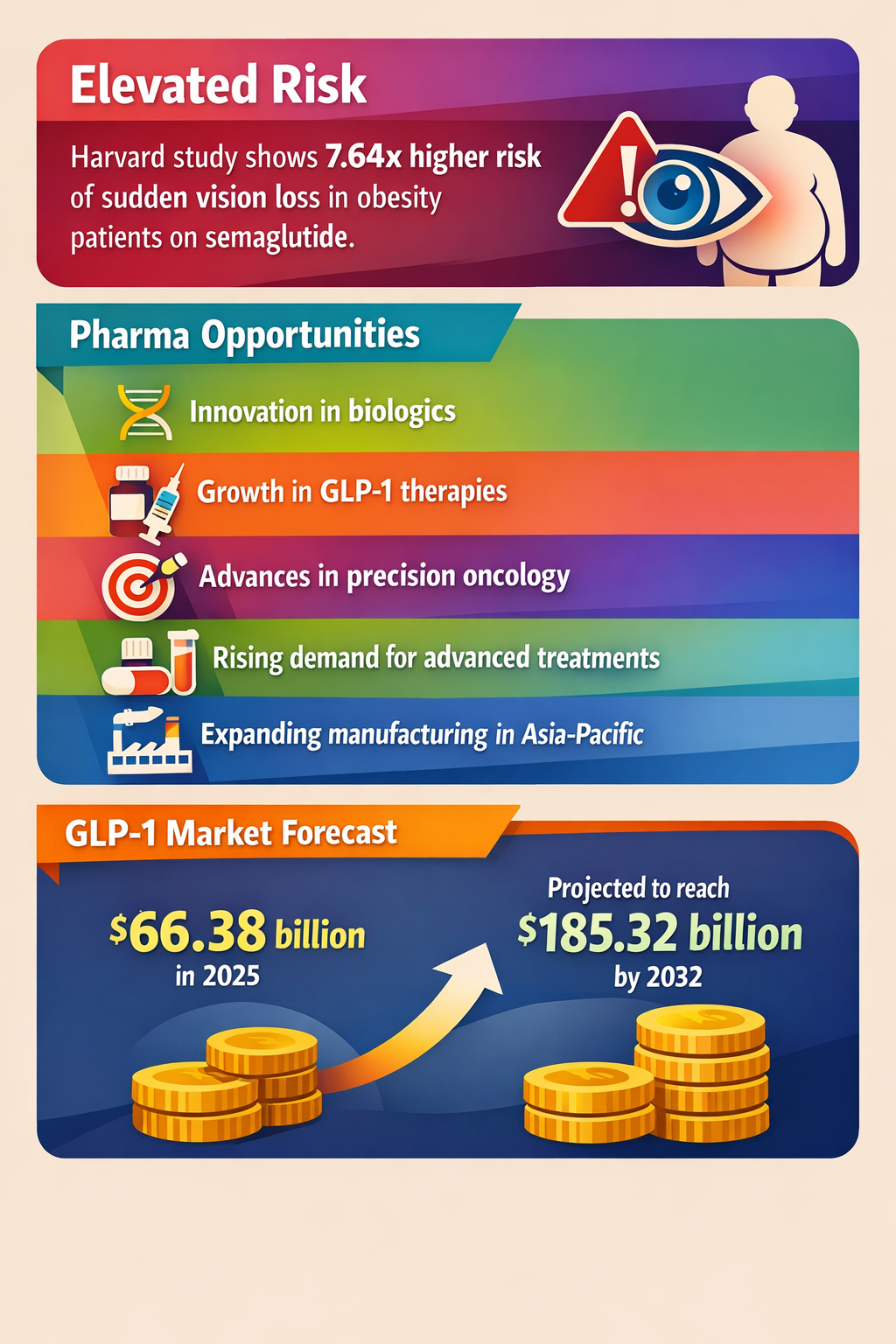
This is a weak signal with mounting urgency and potential for an emergent inflection point in the obesity therapeutic landscape. While GLP-1 drugs are broadly celebrated for efficacy and growth (Global Pharmaceutical Industry Opportunity Outlook Report 16/04/2026), an independent Harvard study exposing a 7.64-fold elevated risk of sudden vision loss introduces a critical safety signal (GLP-1 Vision Lawsuit 16/04/2026). The signal qualifies on the basis of growing litigation, regulatory reassessment, and payer-level restrictions simultaneously emerging. With a 5–10 year horizon and medium-to-high plausibility, affected sectors extend beyond pharmaceutical R&D and manufacturing to include regulatory agencies, insurance providers, and clinical care frameworks.
What Is Changing
The pharmaceutical industry is experiencing a convergence of rapid GLP-1 drug innovation and expanding consumer demand, making these drugs a cornerstone opportunity in obesity treatment (Global Pharmaceutical Industry Opportunity Outlook Report 16/04/2026). However, this growth is now intersecting with emergent safety concerns. The Harvard study highlighting a significantly elevated risk of irreversible vision loss in obesity patients using semaglutide (GLP-1 Vision Lawsuit 16/04/2026) challenges earlier risk-benefit assumptions, suggesting that current post-market surveillance may be insufficient or underreported.
Concurrently, the U.S. Office of Personnel Management (OPM) is urging Federal Employee Health Benefits and Postal Service Health Benefits carriers to reassess qualification criteria for GLP-1 medications prescribed for weight loss (Federal News Network 10/04/2026). This introduces potential barriers to coverage, reflecting payer hesitancy amid growing safety and cost concerns. This marks a shift from broad access towards more stringent vetting of candidates for these drugs.
The emerging safety issue represents a substantive structural theme: the friction between novel, high-demand therapies in obesity treatment and latent, serious adverse effects. This tension is under-recognized outside legal and specialized clinical circles. The interplay between clinical risk signals, litigation potential, and insurance coverage signals a future recalibration of trust, regulatory rigor, and investment risk premia within this sector.
Disruption Pathway
The vision loss safety signal may evolve into structural change through sequential mechanisms. Initially, increasing patient reports and litigation activity could escalate regulatory scrutiny, prompting renewed post-market safety reviews and possibly differential drug labeling or usage restrictions. This could accelerate if case-control studies or real-world data corroborate the Harvard findings, increasing regulatory risk premiums for GLP-1 trials and approvals.
Heightened regulatory caution may induce payers like OPM and private insurers to implement more restrictive criteria or prior authorization hurdles, fragmenting market access and slowing patient uptake. This insurance-driven constraint could stress the commercial viability of GLP-1 obesity drugs and shift corporate strategies towards pipeline diversification or geographic diversification in markets with variable regulatory tolerance.
Pharmaceutical manufacturers may respond with intensified investments in safer next-generation molecules, targeted delivery mechanisms, or biomarker-based patient stratification to mitigate risks. Failure to innovate may lead to heightened liability exposure, eroding investor confidence and elevating capital costs for GLP-1 programs.
Feedback loops might include a cycle where adverse event publicity depresses demand, leading firms to raise prices to compensate, triggering payer pushback and further access constraints. Conversely, increased transparency and risk-mitigation strategies may rebuild trust and stabilize market dynamics over the long term. Fundamental shifts in the regulatory framework could emerge, emphasizing comprehensive real-world safety surveillance as a condition for therapeutic approval and reimbursement, thus altering industrial and governance models.
Why This Matters
For capital allocators, the emergent vision loss safety signal implies increased risk and potential valuation volatility for GLP-1-centric drug portfolios. Investment theses premised on unmitigated market expansion must incorporate regulatory and payer risk layers stemming from adverse event disclosures.
Regulators face pressure to reconcile innovation incentives with patient safety, possibly introducing new frameworks for real-world evidence integration and risk-based conditional approvals. This could also reshape regulatory prioritization and resourcing, requiring interagency coordination and enhanced post-launch pharmacovigilance infrastructure.
Insurance carriers and healthcare systems must evaluate cost-benefit tradeoffs amidst uncertain long-term safety, impacting formulary design, eligibility criteria, and chronic disease management protocols. Payers may encounter legal and reputational risks if mandated coverage leads to adverse outcomes.
Industry competitors may reposition strategically, either doubling down on GLP-1 analogs with safety enhancements or accelerating alternative obesity treatment modalities such as gene therapies or metabolic devices. Supply chains also face shifts in demand patterns linked to regulatory and reimbursement evolutions.
Implications
The vision-related safety signal may catalyze structural changes in pharmaceutical regulation, payer coverage strategies, and innovation trajectories in obesity drug development. It is likely to amplify due diligence and risk modeling in drug candidate selection and portfolio management.
This development should not be conflated with transient adverse event noise typical of early pharmacovigilance phases; the magnitude and specificity of the risk suggest system-level consequence. However, some industry narratives may interpret ongoing safety investigations as manageable iterative challenges rather than inflection points, generating competing interpretations.
Relying solely on initial GLP-1 success stories risks underestimating systemic vulnerabilities related to safety surveillance and patient outcomes in real-world heterogeneous populations. Hence, strategic positioning must integrate this weak signal into scenario planning for mid-term market contingencies.
Early Indicators to Monitor
- Registry data and peer-reviewed publications quantifying ocular adverse events linked to GLP-1 medications
- Regulatory advisory committee meetings or safety label updates by the U.S. Food and Drug Administration (FDA) or European Medicines Agency (EMA)
- Insurance carrier policy revisions and prior authorization rule changes for GLP-1 coverage
- Emergence of specialized patent filings for safer GLP-1 derivatives or alternative obesity therapeutics
- Litigation filings and class-action lawsuit developments involving GLP-1 related vision loss claims
Disconfirming Signals
- Comprehensive epidemiological studies refuting causal linkage between GLP-1 use and vision loss
- Regulatory declarations affirming current safety profiles without label or access changes
- Rapid introduction and market uptake of next-generation, safer GLP-1 drugs obviating concern
- Wide-scale insurer expansion of coverage without tightened restrictions
- Clinical guidelines reaffirming GLP-1 class drugs as standard of care without reservation
Strategic Questions
- How should regulatory agencies integrate post-market vision safety signals into ongoing approval and surveillance frameworks for GLP-1 and related obesity treatments?
- What capital allocation adjustments should pharmaceutical investors undertake in light of evolving safety and payer access uncertainties?
Keywords
GLP-1; obesity treatment; pharmacovigilance; drug safety; regulatory risk; pharmaceutical innovation; insurance coverage; capital allocation
Bibliography
- Opportunities in the pharmaceutical industry include innovation in biologics, growth in GLP-1 therapies and precision oncology, rising demand for advanced treatments, and expanding manufacturing in Asia-Pacific. Global Newswire. Published 16/04/2026.
- The Harvard study found a 7.64 x elevated risk of sudden vision loss in obesity patients taking semaglutide. GLP-1 Vision Lawsuit. Published 16/04/2026.
- For obesity treatment plans in 2027, OPM is calling on FEHB and PSHB carriers to revise requirements, as needed, for members before they can qualify for coverage of GLP-1 medications prescribed for weight loss. Federal News Network. Published 10/04/2026.
- FDA Public Advisory Committees on GLP-1 safety updates (for example, October 2025 meeting notes consolidate emerging real-world evidence). U.S. Food and Drug Administration. Published 20/10/2025.
- Recent peer-reviewed meta-analysis on GLP-1 class ocular adverse events and real-world safety data trends. PubMed Central. Published 04/12/2025.