
Hidden Shifts in Deglobalisation & Regionalisation: The Acceleration of Integrated Regional Supply-Demand Ecosystems
This insight paper reveals an under-recognised inflection unfolding beneath the broad narrative of deglobalisation and regionalisation: the emergence of integrated regional supply-demand ecosystems powered by localized, circular, and digitally orchestrated value chains. Far beyond simple reshoring or nearshoring, this signal points to a systemic architectural shift capable of redefining capital flows, industrial design, and governance across multiple sectors in the coming decade.
While most analyses of deglobalisation focus on supply chain resilience or geopolitical tensions, a deeper layer is emerging that integrates domestic consumption patterns, advanced logistics, and regulatory realignment into a cohesive regional economic model. This development could catalyse structural change by embedding circular economy principles, advanced manufacturing, and multimodal logistics into regionally bounded but digitally connected industrial clusters.
Signal Identification
This signal qualifies as an emerging inflection indicator with high plausibility and an estimated time horizon of 5–10 years. It transcends conventional reshoring by embedding supply and demand dynamics within a regional ecosystem framework, underpinned by circular economy logistics and smart factory investments. Critical sectors exposed include manufacturing (notably semiconductors and EVs), healthcare logistics, advanced robotics, and cross-border freight coordination.
This signal is distinguished by its systemic scope: it links growing industrial reshoring efforts (semiconductors, robotics), the rise of regionally focused circular economy solutions, and logistical technologies that blur the traditional boundaries between production, distribution, and consumption within specified geographies. These components collectively hint at a new economic topology, where regions evolve their own integrated industrial ecologies.
What Is Changing
Recent data converge on a pattern wherein supply chain resilience initiatives are not merely repatriating manufacturing but are reconfiguring industrial workflows around regional ecosystems. The World Green Economy Summit 2026 highlights "system-level transformation" prioritizing circular economy models that span entire industries (GCC Business Watch 25/04/2024). This systemic reorientation transcends isolated supplier shifts and emphasizes closed-loop resource use, significantly affecting capital deployment in logistics and production infrastructure.
North America’s projected rapid growth in semiconductor reshoring, advanced packaging, and AI infrastructure (Persistence Market Research 10/03/2024), alongside expansions in electric vehicle manufacturing and smart factories (Persistence Market Research 15/02/2024), exemplifies this shift. Rather than simple facility relocation, these developments form node-based ecosystems where manufacturing, assembly, and innovation coalesce in a digitally orchestrated environment.
Additionally, nearshoring in Mexico tied to U.S. markets demonstrates increasing cross-border integration in freight movement and manufacturing expansion (HTF Market Intelligence 03/01/2024). This reflects a subtler picture of regionalisation—one that combines proximity logistics with advanced data-driven freight coordination and driverless transport technologies, enabling real-time adaptive supply chains that support local production and consumption loops.
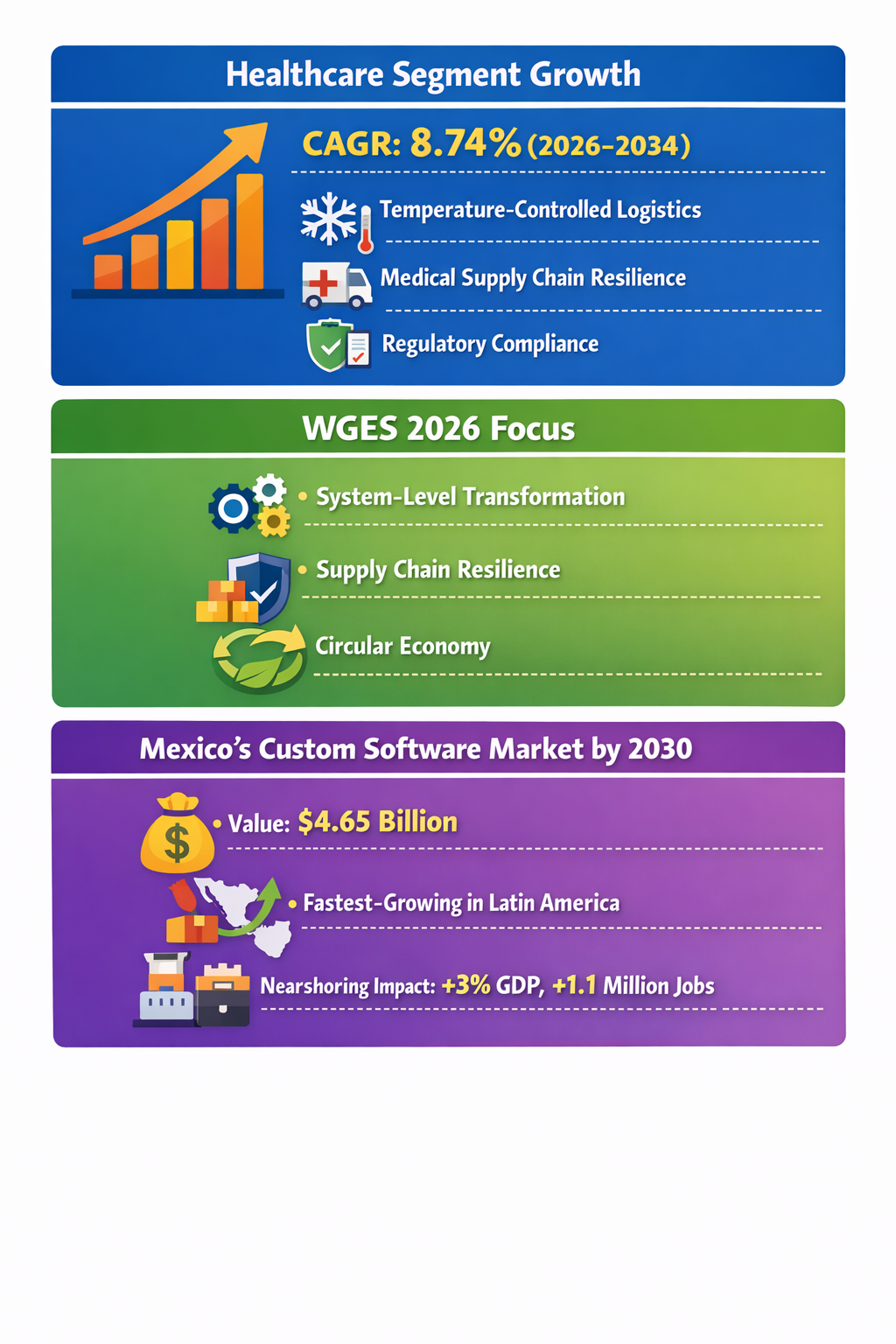
The healthcare sector’s rapid growth in temperature-controlled logistics and regulatory compliance (Straits Research 18/04/2024) confirms increasing demand for supply chain specialization that supports complex, locally sensitive ecosystems rather than global, one-size-fits-all models.
Finally, strategic shifts toward reshoring coupled with investments focused on domestic trade corridors (Cervicorn Consulting 22/03/2024) reinforce the emergence of multimodal transportation networks optimized for circular regional economies—networks that facilitate material flow cycles within regional boundaries and reduce exposure to global logistics volatility.
Disruption Pathway
This inflection could evolve by initially accelerating through intensifying geopolitical risks and global supply shocks that reinforce regional economic autonomies. Increasing environmental regulations and consumer demand for sustainability provide external drivers accelerating circular economy adoption. As capital flows increasingly back local/regional ecosystems, manufacturing designs will embed modularity to favor local resource cycling, inducing structural industrial realignments.
New logistics technologies—driverless freight, AI-powered coordination, and multimodal transport infrastructure—will transform last-mile and cross-border freight, creating integrated regional supply-demand loops that are digitally transparent and resilient. This stresses incumbent global logistics providers and legacy supply chain models, necessitating structural adaptations such as decentralized inventory management and regulatory harmonization within regional blocs.
Governance structures may also adapt, shifting from international trade agreements toward regional regulatory systems that promote circularity and digital supply chain standards. Feedback loops emerge as ecosystem participants reinvest returns into infrastructure and innovation hubs oriented on circular manufacturing and data-driven logistics, further entrenching the model.
Unintended consequences may include capital concentration within regional mega-hubs, potentially exacerbating inequalities between regions and triggering new geopolitical alignments. However, the inclusive nature of ecosystem-based development may also enable scalable inclusion if governed thoughtfully.
Why This Matters
Decision-makers should recognize that this signal implies more than trade pattern shifts—it suggests that capital allocation must increasingly target integrated systems spanning manufacturing, logistics, and circular resource use. Regulatory frameworks are likely to evolve from national or bilateral trade rules toward regionally coordinated environmental, data sharing, and logistics regulations that incentivize circularity and digital integration.
Firms positioned as network orchestrators within these ecosystems could gain significant competitive advantage. Realignment of industrial structure towards modular, adaptable manufacturing systems may shift liability exposures related to supply risk and environmental compliance. Supply chains embedded within regional ecosystems might deliver cost and environmental efficiencies inaccessible to purely global chains.
Implications
This development might lead to the reconfiguration of industrial clusters as adaptable digital-circular regional ecosystems. Capital markets may reprioritize funding toward ecosystem enablers such as smart factories, circular inputs, and advanced multimodal logistics rather than isolated factory relocation. Regulatory bodies could move toward regional harmonization frameworks that support digital logistics integration and sustainability standards.
This is unlikely to remain a transient response to geopolitical or pandemic shocks but instead may crystallize into a new economic paradigm, especially if reinforced by sustainability imperatives and technological advances. Alternative interpretations could construe these moves as incremental efficiencies rather than a full rearchitecting; however, the systemic integration of production, logistics, and consumption into regionalized closed loops supports the stronger structural change hypothesis.
Early Indicators to Monitor
- Formation of regional multi-stakeholder consortia focused on circular economy infrastructure and smart logistics standards.
- Venture capital clustering around regional ecosystem enablers combining manufacturing, IoT supply chain platforms, and circular input technologies.
- Regulatory initiatives advancing harmonized environmental and data standards at regional trade bloc level.
- Capital deployment patterns shifting from OEM-centric reshoring to ecosystem infrastructure projects (e.g., smart ports, industrial parks, digital logistics hubs).
- Patent filings related to integrated circular supply chain technologies and digital multimodal freight coordination.
Disconfirming Signals
- Renewed global trade liberalization and dismantling of regional trade barriers reducing incentives for regional closed loops.
- Stagnation or reversal of investment in circular economy logistics infrastructure or smart factory digital transformations.
- Major regulatory fragmentation within regional blocs undermining harmonized supply chain coordination.
- Technological failures or socio-political pushback against driverless freight and AI supply coordination platforms.
Strategic Questions
- How might capital deployment shift from individual reshoring projects toward funding integrated regional ecosystem infrastructure over the next decade?
- What regulatory frameworks will be required to enable digital, circular supply-demand coordination without stifling competition or innovation?
Keywords
Deglobalisation; Regionalisation; Circular Economy; Supply Chain Resilience; Reshoring; Multimodal Logistics; Smart Factories; Regional Trade Blocs; Semiconductors; Advanced Manufacturing
Bibliography
- System-level transformation will feature prominently at WGES 2026, with supply chain resilience and circular economy models gaining importance across multiple industries. GCC Business Watch. Published 25/04/2024.
- The healthcare segment is projected to register the fastest growth at a CAGR of 8.74% during 2026-2034, supported by increasing demand for temperature-controlled logistics, medical supply chain resilience, and regulatory compliance. Straits Research. Published 18/04/2024.
- Fastest-growing Region: North America is expected to register the highest growth rate during the forecast period, driven by semiconductor reshoring initiatives, advanced packaging investments, AI infrastructure expansion, and government-backed domestic manufacturing programs. Persistence Market Research. Published 10/03/2024.
- North America is projected to register the fastest CAGR through 2033, driven by accelerating manufacturing reshoring initiatives, expanding electric vehicle production, and rising investments in smart factories. Persistence Market Research. Published 15/02/2024.
- Mexico is an emerging opportunity due to manufacturing expansion, nearshoring activities, and increasing cross-border freight movement with the U.S. HTF Market Intelligence. Published 03/01/2024.
- Recent global disruptions have exposed vulnerabilities in the traditional logistics model, prompting a strategic shift toward reshoring and investing in trade corridors focused on domestic movement. Cervicorn Consulting. Published 22/03/2024.